[Note: photos, and text revisions, to come]
Breakfast was amusing. 6 of us showed up early--the two physicians, the lady of leisure and her guide, Pop and I. Everyone had chosen something different from the available "cooked breakfast" options. The psychiatrist was poking dubiously at something advertised as "rancher's eggs"--a Britished version of huevos rancheros; the GP had soft boiled eggs in little egg cups; Pop tried the "traditional Northumbrian breakfast" with sausage and bacon, eggs, mushrooms, grilled tomatoes, and baked beans (he was quite happy to note the absence of black pudding (a traditional sausage of pork fat, oatmeal, and blood); the guide was tucking into scrambled eggs and bacon; I, being egg averse and thus limited in my options, was tackling a large kipper; and the lady of leisure and fitness buff, who announced that she hates breakfast, was having tea and Marlboros. She kept popping out between cups of tea to have a cigarette, but she eventually decided it was more fun to stay and watch me wrestle with the kipper. A proper Brit would, of course, eat the kipper bones and all, but I'm not much more keen on fish bones than I am on eggs, so I was tweezering them out with fork and fingers as I went--a somewhat Sisyphean task.
5 miles today--piece of cake!--not really--getting pretty worn and both feet are blistered badly enough to make each step painful. The body is failing, but the spirits are still most contented. We are now in full Wall territory--extensive stretches of exposed stone wall with bridge foundations and turrets and mile forts and larger forts and frequent, though still tasteful enough, tourist venues. The fields are larger, with patches of moorland on the far hills. Few cattle; sheep as far as the eye can see.
Hard to see in the photo, but high tension lines march steadily across the horizon below. I imagine the Romans would approve of this orderly imposition of technology and stamp of power on the landscape. I had assumed that Hadrian's army looked out on wilderness, but the museum at Birdoswald Fort claims the landscape had been cleared to farmland before the Romans arrived.
Again excellent accomodations with far better food than hiking across rough country usually offers: tonight a platter of smoked Scottish salmon with cress and pickles, dill mustard, lemon, and brown bread; a sweet and subtle tagine of eggplant, zucchini, tomato, onion, apricot, almond, honey, and spices with chickpeas and tender, succulent lamb; a course of local cheeses with fresh fruit and plum chutney; and a spicy Pinot grigio.
Thursday, May 30, 2013

Day 4: Carlisle to Lanercost (14 miles, 8 hours)
Awoke to grey skies and wind and cooler temperatures (50’s
F), but our hostess said the rain was supposed to hold off until late
afternoon. As we stepped out the door, the first sprinkles hit our faces, so we
pulled out the rain jackets just in case. The weather gods were kind, and we had no more than the occasional light
sprinkle all day, but the jackets turned out to be a good idea anyway, as the
wind shifted from pleasant to bracing as the day wore on and we climbed out of
the river’s plain into rolling hills. Carlisle’s residential and industrial
suburbs gave way to rolling hills and larger fields than yesterday’s—cows at
first, then mostly sheep.
Up until now we have more or less followed the line of the Wall, but there haven't been any visible remains. Today we began to see hints of the Wall--first an open field where we walked along a long, straight mound and trench system--the remains of the Vallum, which was built to the south of the Wall, sometimes quite close, where the terrain allowed, elsewhere at some distance (where the Wall goes over the crags of the Whin Sill, the Vallum was built in the valley below).
http://www.roman-britain.org/frontiers/hw_history.htm
http://en.wikipedia.org/wiki/Vallum
http://structuralarchaeology.blogspot.com/2010/11/40-reverse-engineering-vallum.html (a discussion of the Vallum's construction and possible purpose).
Later we walked a stretch of Path built on top of the Wall (apparently the rock of the Wall was too close to the surface for hedgerows to take root, so it was hedged on either side in the 18th or 19th Century--now an attractive stretch riddled with badger holes).
Today there was no good stopping place for lunch, so we ordered sandwiches from the hotel. Ham and tomato was uninteresting, but cheddar with tomato and Branston Pickle (rutabagas, carrots, onions, cauliflower, and gherkins in a sweet, spicy, vinegary pickle) was a keeper. Pretty much anything eaten sitting in the grass in a corner of a cow pasture after 3 hours of walking in the wind will hit the spot, but sharp and sweet and creamy and crunchy is particularly nice.


The last 3 miles were pretty tough going—long climbs up and down and increasingly steep. Tonight B&B is beside the River Irthing close by Lanercost Priory, but the Wall Path passes Lanercost high above the valley. Tomorrow we will start our trek back up ¾ mile of steep road before turning into the Path again, which looked to be still more climbing, but through grassy sheep pasture (another stretch of “not visible” path).


Tonight’s B&B is the most comfortable of our accommodations
so far—a spacious, nicely decorated room , inviting common rooms, peaceful
scenery out the window, and an interesting home-cooked dinner (a starter of baked
mushroom cap with spinach and mixed
onion stuffing with a side of mixed
greens; crusty baguette; chicken legs in casserole with Spanish chorizo and
roasted root vegetables and a side of ratatouille; strawberries in clotted cream with sugar lumps). Eaten communally—10 people at the table, all
Wall walkers, some heading west to east , others east to west, some finishing
in 6 days, others in 8 or 10 —two married
couples, a father and young teenage son, Pop and I, and a self-styled “lady of leisure,”
walking the Path with her own private guide. We were seated between the lady of leisure and her guide and the older married
couple, she a GP and he a psychiatrist, so the conversation ranged from UK/US
medical training and funding systems, to children “at university” (in college),
to Wall history to British farming techniques and history, to interesting ways
to fill one’s time if one lives a life of leisure (in our dinner companion’s
case, “lots of tennis, fitness activities, trips like this, and skiing”).
 |
| Rickerby Park, Carlisle |
 |
| Carlisle suburbs, east |
 |
| Still in the river's plain |
 |
| Suburb blending into farmland |
 |
| Royal Mail box set in side of barn above |
 |
| Garden wall |
 |
| The same |
 |
| Over the garden wall |
 |
| Down the street a bit |
 |
| The same |
 |
| Sheep under lowering skies |
 |
| Bluebells at the bottom of a manor house garden |
 |
| From as distance I thought these were real flower balls |
 |
| But alas--plastic. Quite handsome from a distance |
Up until now we have more or less followed the line of the Wall, but there haven't been any visible remains. Today we began to see hints of the Wall--first an open field where we walked along a long, straight mound and trench system--the remains of the Vallum, which was built to the south of the Wall, sometimes quite close, where the terrain allowed, elsewhere at some distance (where the Wall goes over the crags of the Whin Sill, the Vallum was built in the valley below).
http://www.roman-britain.org/frontiers/hw_history.htm
http://en.wikipedia.org/wiki/Vallum
http://structuralarchaeology.blogspot.com/2010/11/40-reverse-engineering-vallum.html (a discussion of the Vallum's construction and possible purpose).
Later we walked a stretch of Path built on top of the Wall (apparently the rock of the Wall was too close to the surface for hedgerows to take root, so it was hedged on either side in the 18th or 19th Century--now an attractive stretch riddled with badger holes).
 |
| First stretch of Vallum obvious to us |
 |
| Tri-color sweaters on the hoof. |
 |
| Cottage at the Path's edge |
 |
| Cottage garden |
 |
| Columbine |
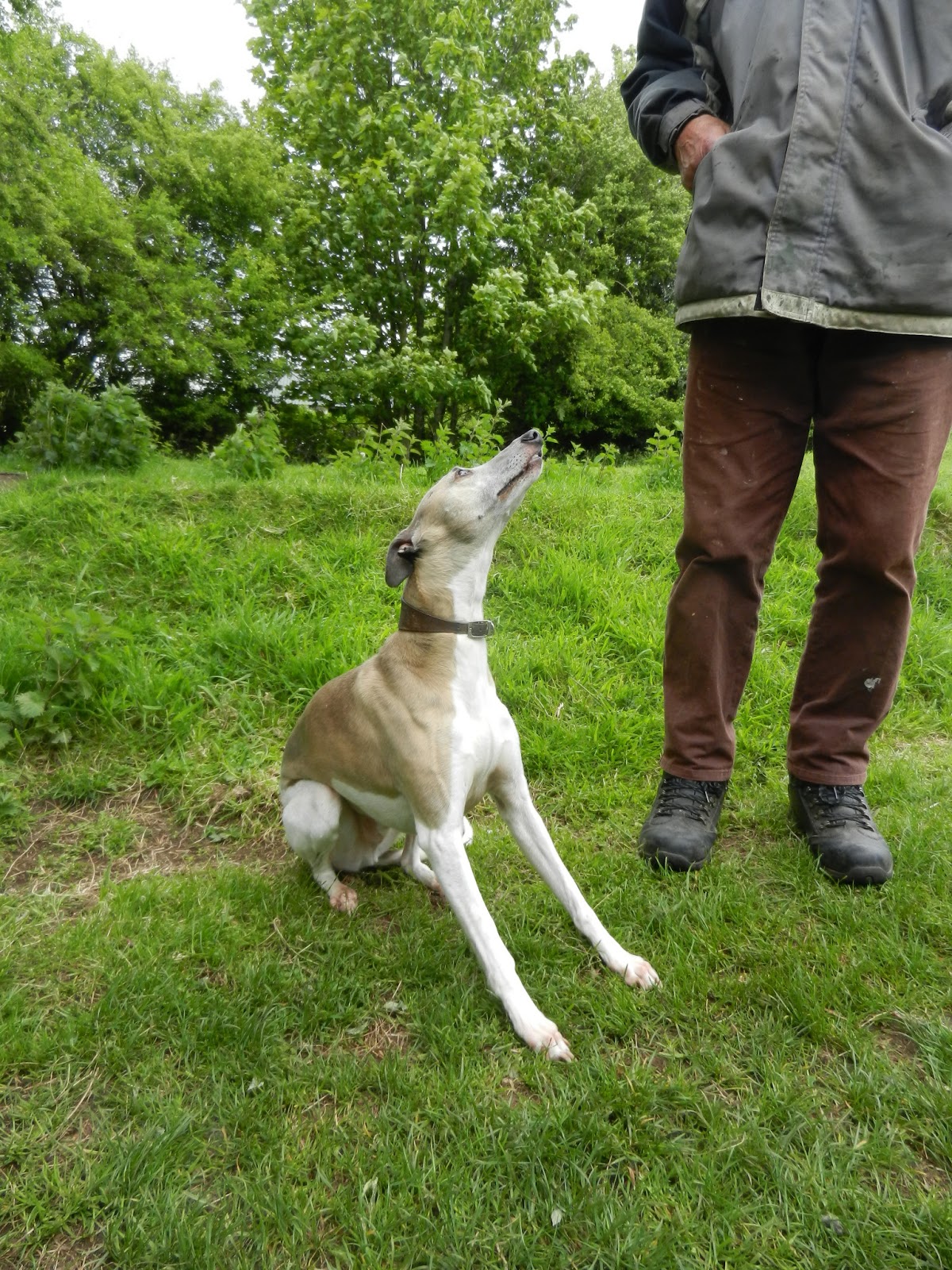 |
| Man and whippet out for a walk |
 |
| Pop checks on my progress |
 |
| Badger hole in Wall |
 |
| The Wall between hedges |
 |
| Grazing on the Wall |
 |
| Wall garden (A wall, not The Wall) |
 |
| Stall scrapings--turnips, manure, straw |
 |
| The Path turns a corner between close fences--looking back |
 |
| Looking ahead |
 |
| Long hill down |
 |
| And through a kissing gate |
 |
| Looking back up from only part way down |
 |
| Faint but visible path |
 |
| Farm yard |
 |
| Potato digger?? |

Today there was no good stopping place for lunch, so we ordered sandwiches from the hotel. Ham and tomato was uninteresting, but cheddar with tomato and Branston Pickle (rutabagas, carrots, onions, cauliflower, and gherkins in a sweet, spicy, vinegary pickle) was a keeper. Pretty much anything eaten sitting in the grass in a corner of a cow pasture after 3 hours of walking in the wind will hit the spot, but sharp and sweet and creamy and crunchy is particularly nice.
 |
| Bluebells in the woods |
 |
| Bluebells by a fence |
 |
| Bluebells by the Path |
 |
 |
| Bluebells on a hill |
 |
| Up another long pasture |
 |
| Muck spredder |
 |
| Bridge |
 |
| Up another long road. Getting very tired |
 |
| Farm yard |
 |
| Distant views |
 |


The last 3 miles were pretty tough going—long climbs up and down and increasingly steep. Tonight B&B is beside the River Irthing close by Lanercost Priory, but the Wall Path passes Lanercost high above the valley. Tomorrow we will start our trek back up ¾ mile of steep road before turning into the Path again, which looked to be still more climbing, but through grassy sheep pasture (another stretch of “not visible” path).


 |
| A stretch of Wall rubble? |
 |
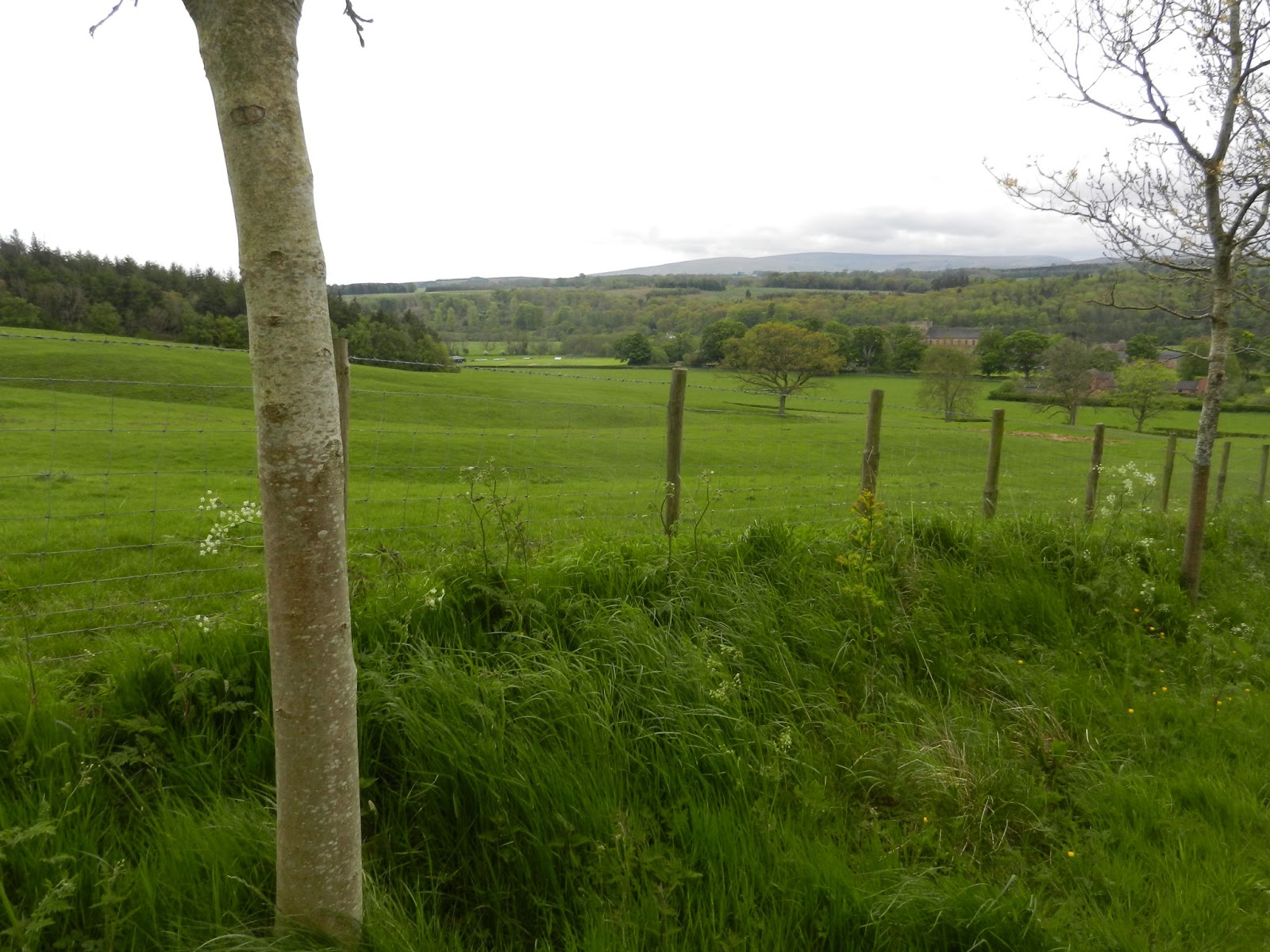 |
| Off the Path, heading down to the River Irthing |

 |
| Lanercost Abbey Bridge, built 1724 |

 |
| Abbey Bridge B&B |
Subscribe to:
Posts (Atom)